Paul Jolly Photography Chapter 7
More aperture effects
The depth of field for film cameras is a subjective judgement as to where the image is determined not to be in-focus; with a digital camera we have another measure.
Taking a single point of light we can focus this onto the sensor, now moving the light source towards or away from the camera the
image at the sensor goes out of focus but this cannot be seen until the light hits the next sensor pixel.
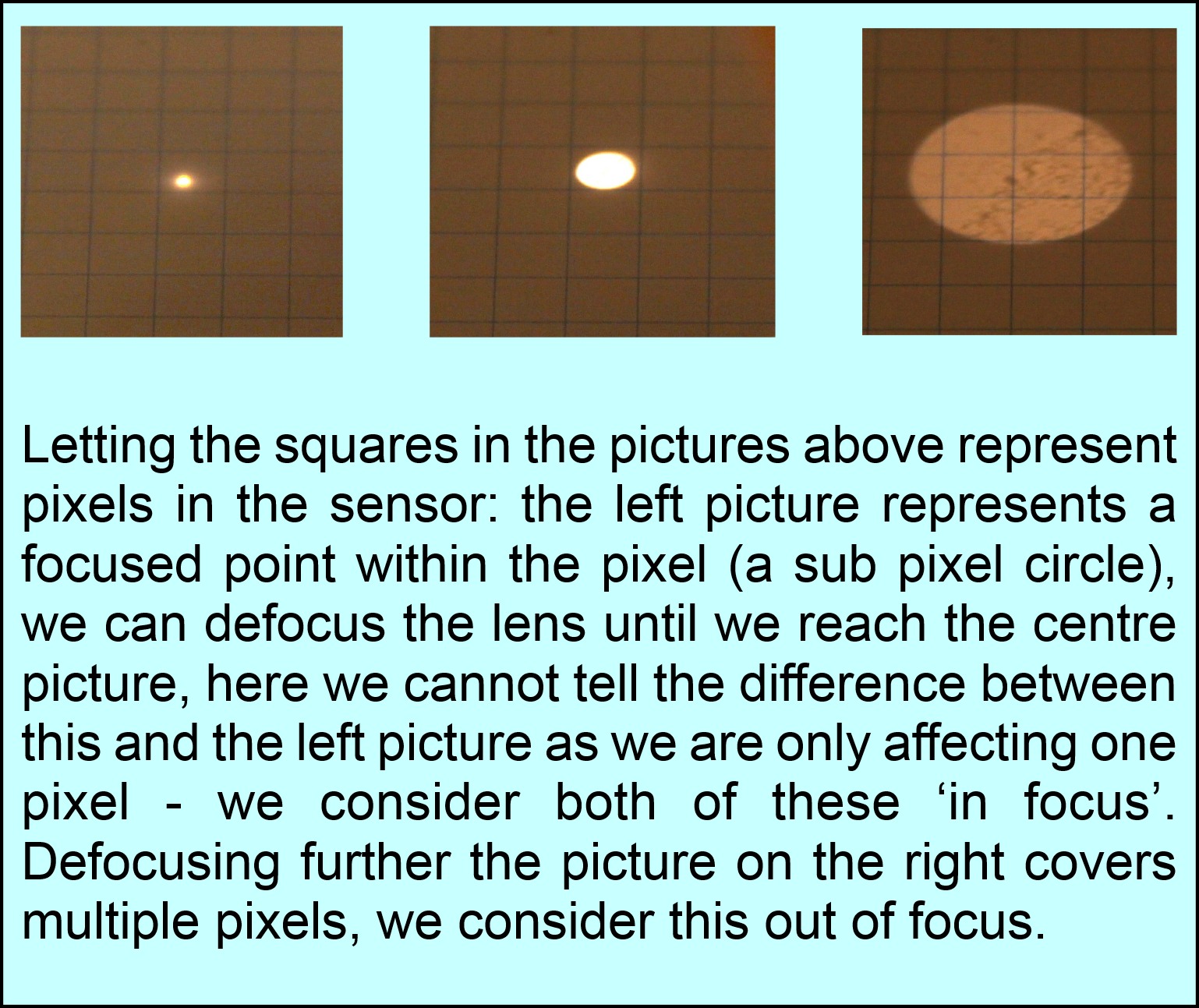
This has the effect that the more pixels you have in your sensor the sooner out of focus is detected; so the more the pixels the smaller the effective depth of field.
With the same number of pixels the larger the sensor (full frame rather than APS for instance) the larger the effective depth of field,
as the size of the pixels are larger in the larger sensor and the image needs to be further out of focus before the light is detected in an adjacent pixel.
Adjacent pixel light blurs the differences between pixels producing an overall blurred image, this is what we call out of focus.
The circle produced from a point source becoming out of focus is called the circle of confusion.
We can define a physical value for out of focus by defining in focus as where the circle of confusion does not touch the adjacent
pixels. Using this definition with the same size sensor, if the number of pixels is increased the lens has to be better because
errors in the lens also increase the size of the circle of confusion. Alternatively if a larger sensor is used with the same number
of pixels, the depth of field is increased or we can use a lower quality lens to give the same focal results.


(C)2024 P.Jolly. Page last updated 20240713