Paul Jolly Photography Chapter 27
Back focus
Back focus is the distance from the optical centre of the lens to the image focal plane of an
object placed at infinity. However the distance often being referred to is the back flange
distance: If you think of a SLR camera the lens fits onto the front using a partial turn grip
or a full screw, the front part of the camera that the lens is held against is the flange.
The back flange distance is the distance between the lens mounting flange and the effective
sensor position. Effective because a cover over the sensor modifies the distance, the cover
is needed to protect the sensor surface from the air.
If doing any lens calculations it is extremely important to remember that the back focus
distance and back flange distance are not the same thing.
Each camera manufacturer has their own back flange distance which is one reason why lenses
from different camera manufactures are not interchangeable without converters.
There are a few standard distances C, CS, F for instance.
For information on fine correction setting of this distance in a camera see the chapter on Micro-focus.
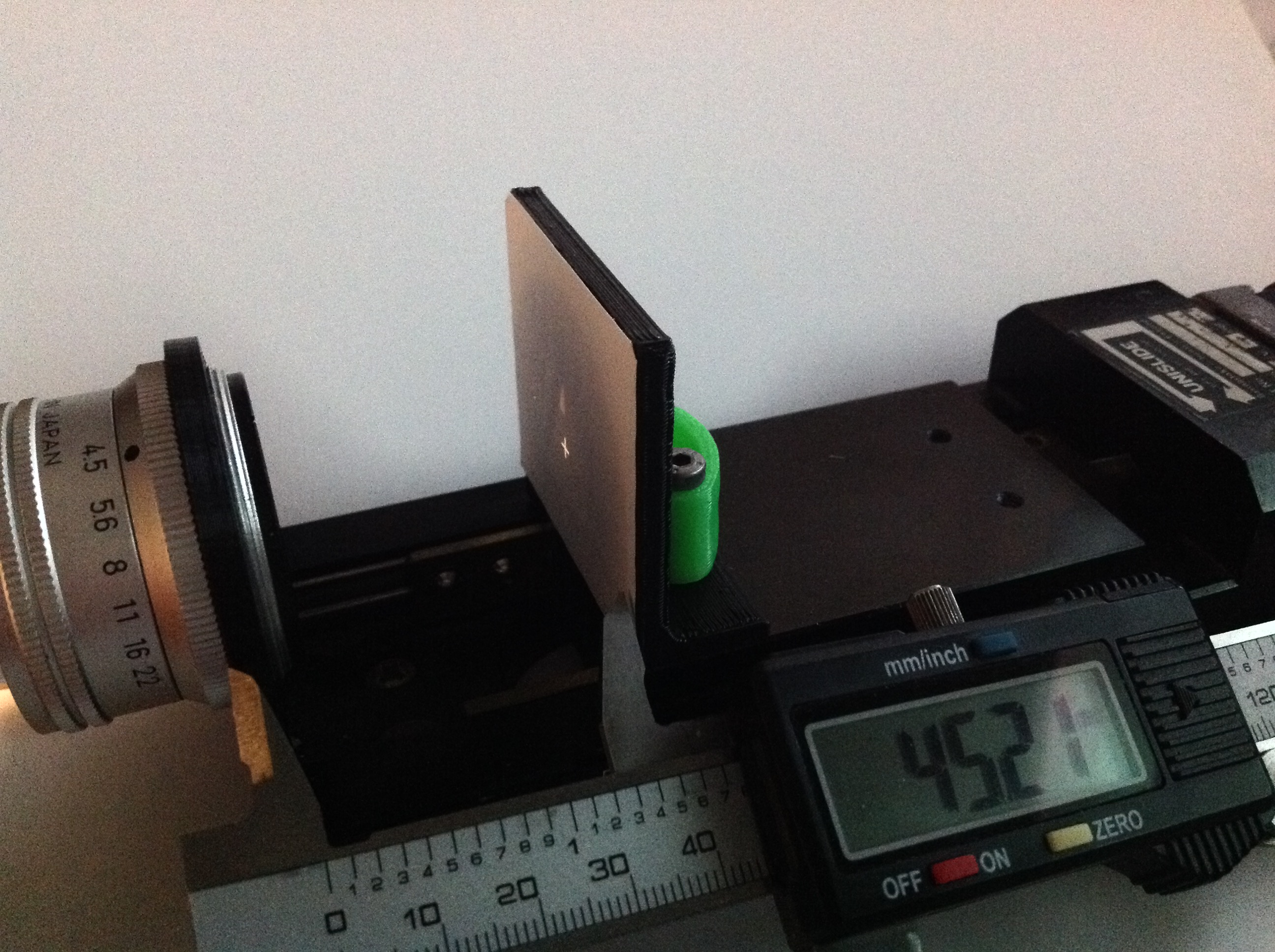
In the photograph above a retro-reflective X was placed on a far wall then with illumination
near the fixed focus lens the micro-slide was adjusted until the X was in perfect focus on
the white rear screen. The measurement shown is the back focus distance from the mounting
flange of the lens to the focused image. The lens is actually from an enlarger and as such
has no focus adjustment of its own and relies on the focal plane being moved but shows the
general idea of back focus.
As the cross was not at infinite distance the actual value measured has to be modified.
Using the sun (with a filter in front of the lens) or preferably the moon will give a
better result as these can be considered an infinite distance away for this test.


(C)2024 P.Jolly. Page last updated 20240713