Paul Jolly Photography Chapter 13
Panoramic photographs
One way to produce a panoramic photograph is to use a wide angle lens and to use just a central horizontal
section of the resulting photograph but this results in lower resolution in the result.

A better method is to take several overlapping photographs and stitch them together in a software program.
Avoid the use of wide angle lenses for this, as light from wider angles will be attenuated.
There are several items to think of here though. Keeping the same exposure for all the photographs minimizes
the amount of work the software has to do and gives a better result. Find the exposure that best suits the
subject then set the camera to manual with these settings.
Just rotating the camera has a problem because as it is rotated the angles between close objects and far
objects differ, this means that the photographs are impossible to correctly stitch together.
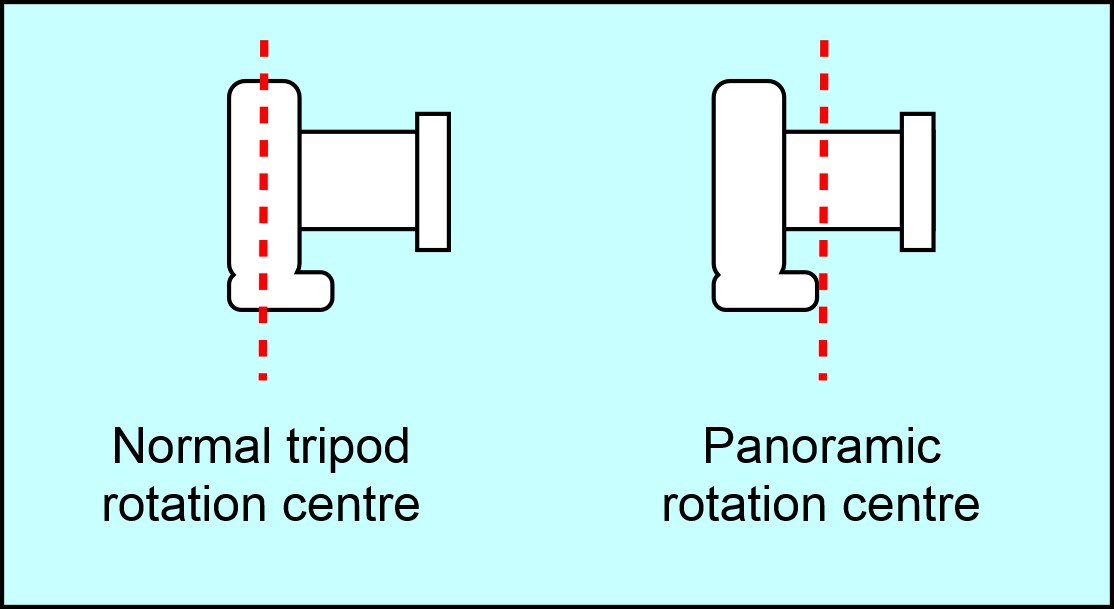
By rotating in the plane of the effective centre of the lens the object angles do not change thus making
the stitching of overlapping photographs possible. The taking of panoramic pictures in this way require
the pictures to be taken over a relatively short period of time to ensure slowly moving items, such as
clouds, to not change position too much. You can see the problem of lens angle vignetting causing darker
patches in the sky in the panoramic view below.
To minimize the problems of faster moving items we can take two or three photographs at each angle and process
the resulting frames to either remove the offending elements or to ensure that they are not in the overlap areas
we wish to use in the stitching software.
The use of a tripod is highly recommended for this type of photography; a panoramic head in which the vertical
rotating axis is positioned in the effective lens plane minimizes the angle problems.
The use of a motorised panoramic head improves the result as it moves the camera between shots and fires the
shutter at each angle automatically. A further improvement comes from positioning speed, this minimizes the
movement of clouds etc between shots.
Do not take your shots edge to edge, you need adjacent shots to overlap otherwise you will find you cannot
complete the panorama. I recommend that you use at least 66% to 80% overlap then if a single shot fails you
still have enough to complete the picture with overlap; it also ensures you can match up the photographs more easily.
Panoramic photographs are not restricted to horizontal, the stitching can also be vertical although in this
case I would recommend a larger overlap for buildings due to the change in focal distance.
Stitching can be combined with multiple exposures in both horizontal and vertical to produce a matrix of
exposures which will effectively increase the number of pixels covering the scene leading (hopefully) to
a higher definition photograph. - Before you go wild over the possibilities just remember you also need
much more storage for these images, and computer RAM to process them.

(C)2024 P.Jolly. Page last updated 20240713