Tape Control Calculations
Background
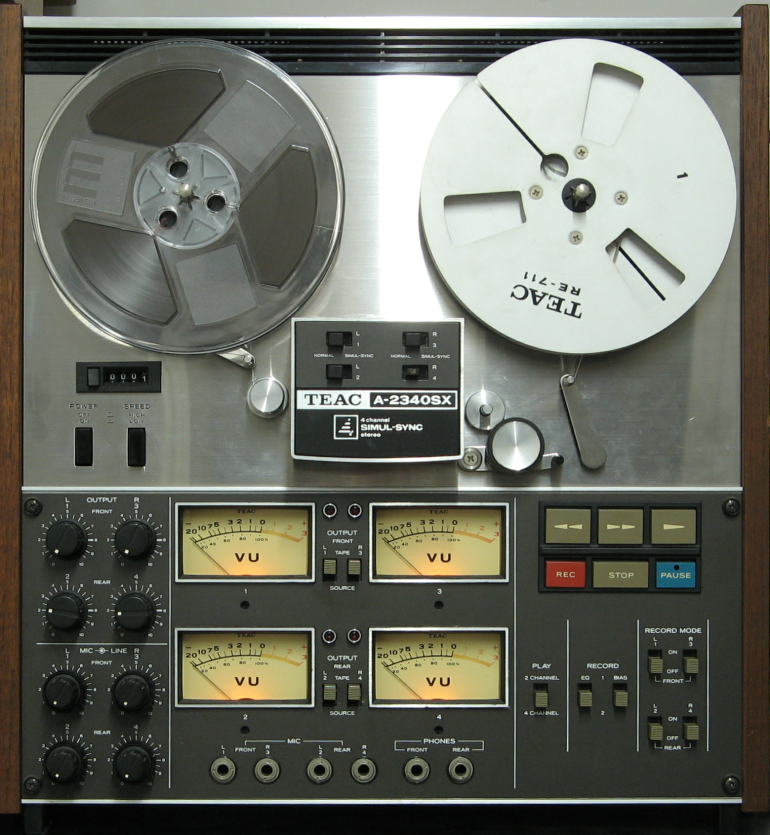
This page was started to determine the position of a recording on a section of reel to reel recording tape
Where the tape length is that on the takeup spool. For this we do need an addition of two opto detectors on the reel (two to know the direction) and connection to the remote control interface if computer control is to be used.
The preference is to use relays for the control interface to isolate the computer / microcontroller from the tape recorder electronics, although high power opto isolators could also be used.
How it works
By using an optical detector pair on the take up spool the number of revolutions in either direction can be determined
Also by engaging the tape play function a known amount of tape can be spooled as the tape speed is known and duration of play can be measured
Using these known facts the empty spool diameter D can be found and the thickness of the tape determined.
Definitions
D = centre diameter of the empty spool (inches)
N = number of turns of the tape on the spool at any time
T = thickness of the tape (inches)
L = length of tape on the spool (inches)
S = speed of the tape in play mode (normally 3.75, 7.5 or 15 inches per second)
x = tape running time in seconds
Calculations
The length of tape on the spool:
L=π(ND+TN(N-1))
Thickness of the tape:
T=(L/π-ND)/(N(N-1))
Number of turns:
N=(T-D+sqrt((D-T)² +(4TL/π))/2T
Initial calcs
With the tape just at the begining of the spool the tape can be run at a known speed for a specific number of revolutions and the time taken noted.
this results in a length of tape determined by:
L=xS where x is the time the tape is running for.
Now, looking at the Length equation L=π(ND+TN(N+1))
if we assume the thickness does not make much difference in the first few revolutions then we can simplify the calculation (assume T→0)
xS = L ≈ πDN
or
D ≈ xS/(πN)
Then by spooling the tape for a known number of revolutions (reasonably large), then measuring the new diameter as above
the tape thickness can be calculated as the diameter increases by 2T for each revolution.
Finally
Now we know D and T, and also the present N, we can rewind to the begining of the tape, or using the length calcultations to anywhere on the tape required just by knowing the current value of N.
Knowing L this also gives up the time on the tape as S is also defined.
Time = L/S seconds.
Extras
If we also take note of the supply spool turns during the start of play and assume the centre diameter is the same as the take up spool then we can determine the total length of tape on the spool.
Notes:
Using the counter, often built into the machine, cannot be used for this as it is not directly connected to the spool; and worse normally connected by a band that can slip and change position making the displayed value inconsistant. Further the counter very rarely counts actual revolutions as the pulleys on the counter and spool are often different sizes.
Text and Pictures (C)2026 P.Jolly all rights reserved. Page last updated 20260319