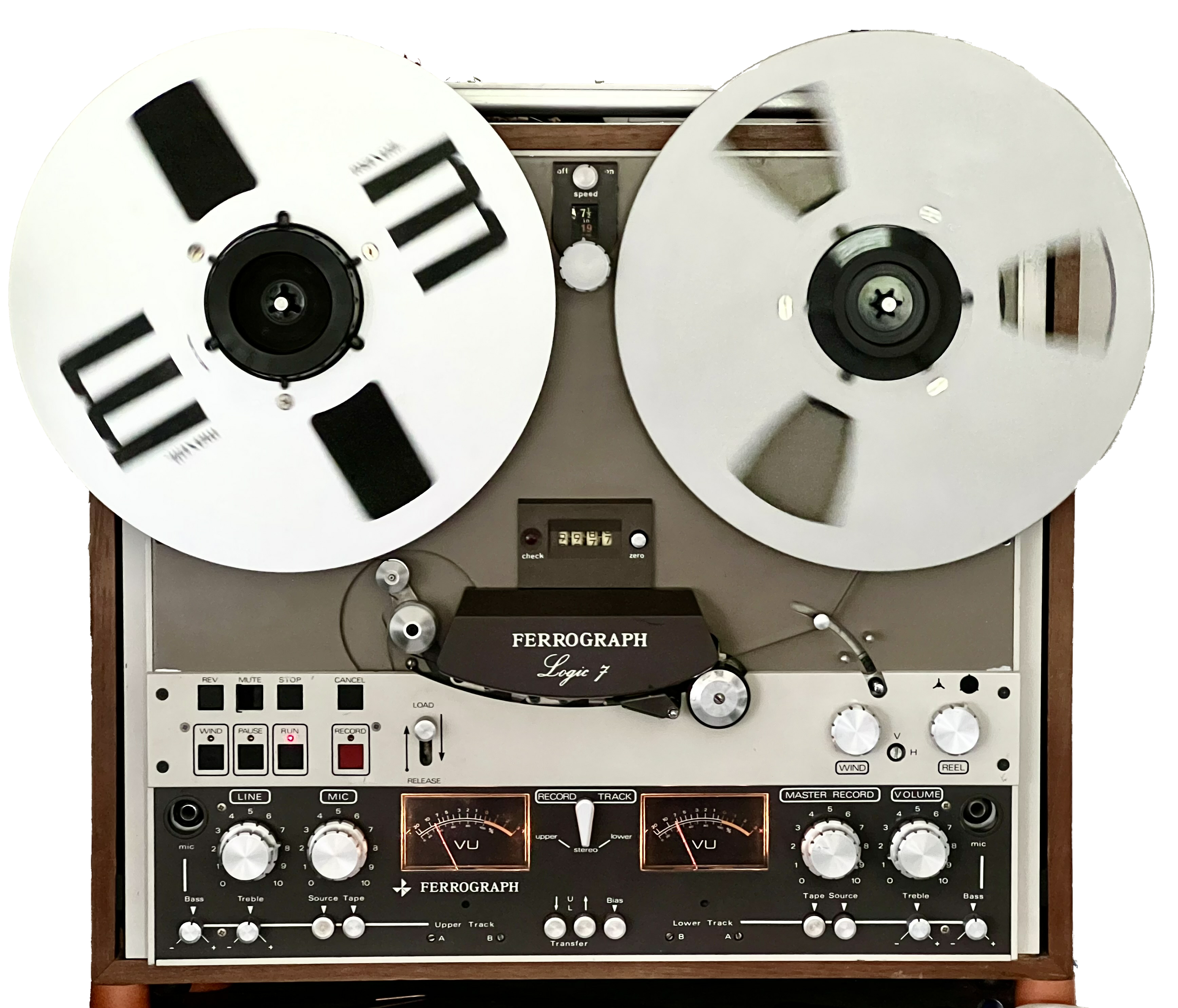
Background
This page showes the differences between tape track layouts and some of the history.
Layouts
Reel to Reel Tape
Here we are referencing quater inch tape.
As common with almost all reel to reel machines the oxide side of the tape (the side you record on) faces the reels on the machine.
For sterio: Red arrows are for the left channel, green arrows for the right channel
 1.
1. The first version of tape recording was to use the full width of the tape, Mono recording was in one direction only as there is only one track.
 2.
2. The next change was to split the width into two, still Mono but the recording was in one direction for one track, then by turning moving the right reel to the left and the left to the right the other track could be used; from the tape's perspective the recording is in the oposite direction.
 3.
3. Sterio came next; using both of the two tracks at the same time, one for left and one for right. However the manufacture of tape heads was not advanced enough so the sterio ws produced using a pair of seperated half track heads, one for the right and one for the left.
The problem with staggered heads was for good recording and payback on a dfferent machine the distance between heads had to be precise. Also playback using a full width head would produce a mono output but with out of alignment left and right channels.
The left track (upper) was recorded on the tape first followed by the right (lower) on the second head.
 4.
4. Soon manufacturing cought up providing a head with the left and right channels vertically aligned, this meant full width mono tapes could now replay two track sterio tapes correctly.
 5.
5. The next step was driven by tape costs: four track sterio. Numbering the tracks from top to bottom as 1, 2, 3 and 4 it was decided to record left on track 1 and right on track 3, turning the tape over as before gave the new left and right on tracks 4 and 2. The problem here is now a two reack machine cannot pay a four track sterio recording correctly as the reverse sound on the other direction tracks would add into the playback sound.
The use of 1,3 and 4,2 pairs chosen to give seperation for the coils needed in the reord and playback heads.
 6.
6. Next step, Quadraphonic: Use of all four channels of a four track tape, reording in one direction once more as tape head manufacturing improved allowing the full four tracks to be used simultaniously.
Track 1 is front left (red), Track 3 is Front Right (green), Track 2 Left Back (dark green), Track 4 Right Back (mauve).
Compact Cassette Tape
Eigth inch Tape.
As common with almost all cassette machines the oxide side of the tape (the side you record on) faces away from the reels on the machine.
1. Cassetts started with two tracks one each way similar to the Reel to Reel version, giving two mono recordings.
 2.
2. Sterio tapes needed to be played on mono machines, forced by the users as anything else would require users to purchase new machines, one for mono and one for sterio machines.
Because of the manufacturing capability the four tracks of the sterio tapes (if we number them from top to bottom as 1, 2, 3 and 4) cound now have the sterio in one direction on tracks 1 and 2, the oposite direction is on tracks 4 and 3.
Due to this arangement the sterio and erase heads are the same, erasing a pair of tracks at once, the disadvantage of this being both left and right tracks have to be recorded at the same time.
3. A further change was to make a full four channel head, this allows an auto reverse play without turning the tape over.

This was also used for multi channel recorders where the tape was only recorded in one direction as the full width was then taken up.
Erase Heads.
Reel to reel
For reel to reel the tape heads followed that for the tracks as one would expect.
1. For reel to reel the tape heads followed that for the tracks as one would expect.
2. The full track Eerase head is an obvious one.
3. Stagged Sterio heads required staggered erase heads for consistancy. Note: editting staggered head tape by splicing was not possible.
4. Once the Sterio was in line the erase head was then also in line, and splicing for edit was simple. This stage also ment the number of heads decreased.
Cassette
1. For Cassetts the erase for mono and sterio was the same; half the tape width.
2. Only when all four channels were used for multitrack recording did the erase head requirement for individualy selectable track erasure become required; thus a four channel erase head.
Text and Pictures (C)2026 P.Jolly all rights reserved. Page last updated 20260324