Background
This page had been written to explain the frequency responce of a reel to reel tape recorder when it is limited by the tape head gap.
Information is split here into playback, erase and Record heads. This arangement has been designed to step the reader through the various reasons the gap is importent.
Playback head
1. Thinking about the head gap, the signal being recovered is dependant on the width of the head gap. The problem is the larger width will produce a larger signal but the more of the sinewave that is contained within the gap the lower the output. Once the wavelength is equal to the head gap the output would be zero.
With a faster speed of tape this makes the relative size of the gap smaller.
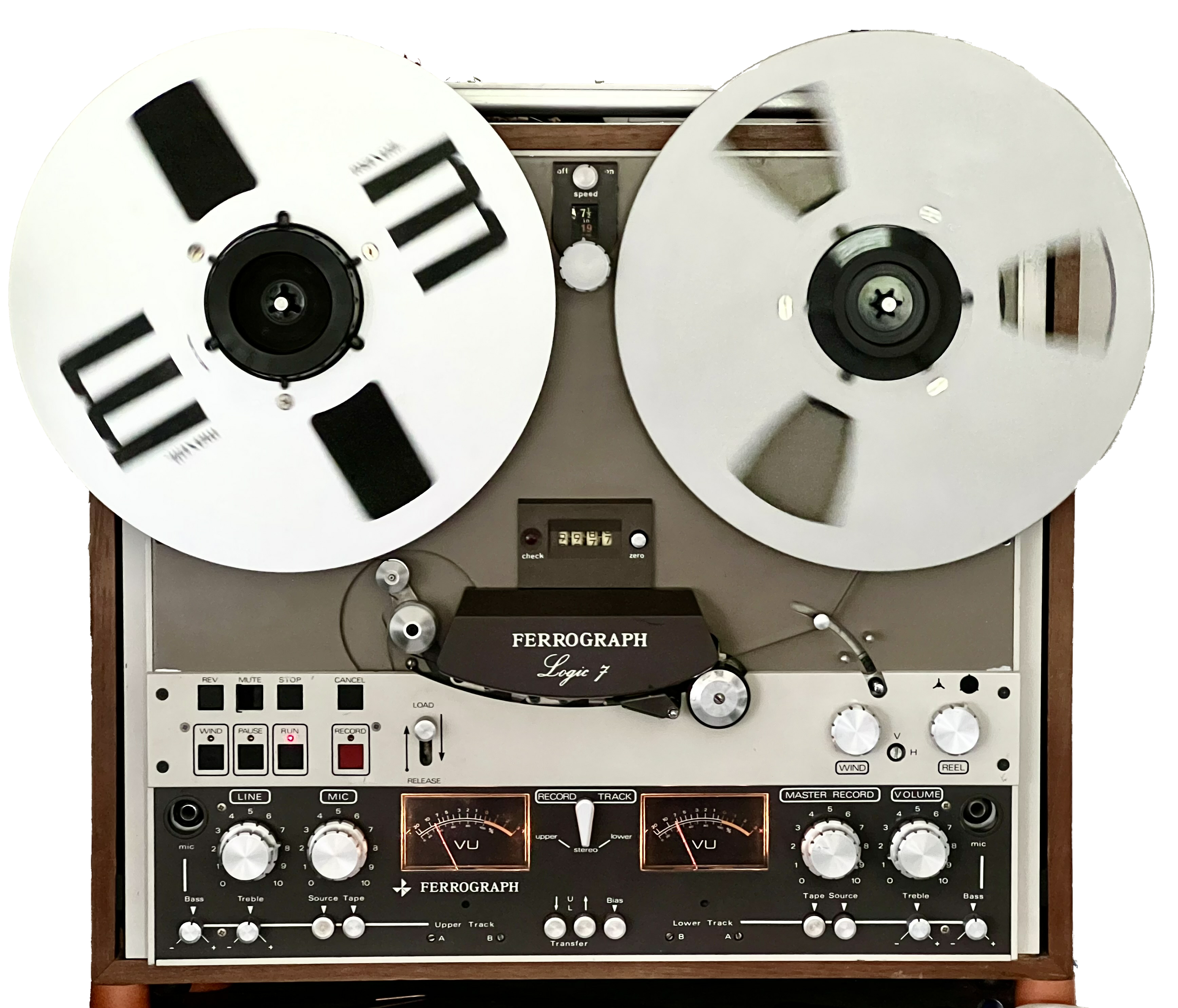
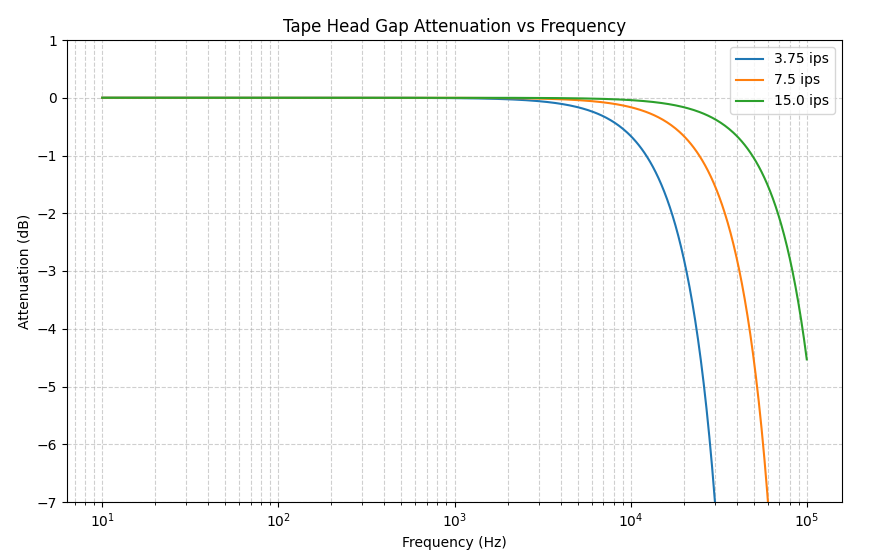
2. Looking at a reel to reel tape recorder with a 2 micron head gap (in this case a 4 track Ferrograph Logic 7) we can plot the amplitude against frequency for different tape speeds:
 3.
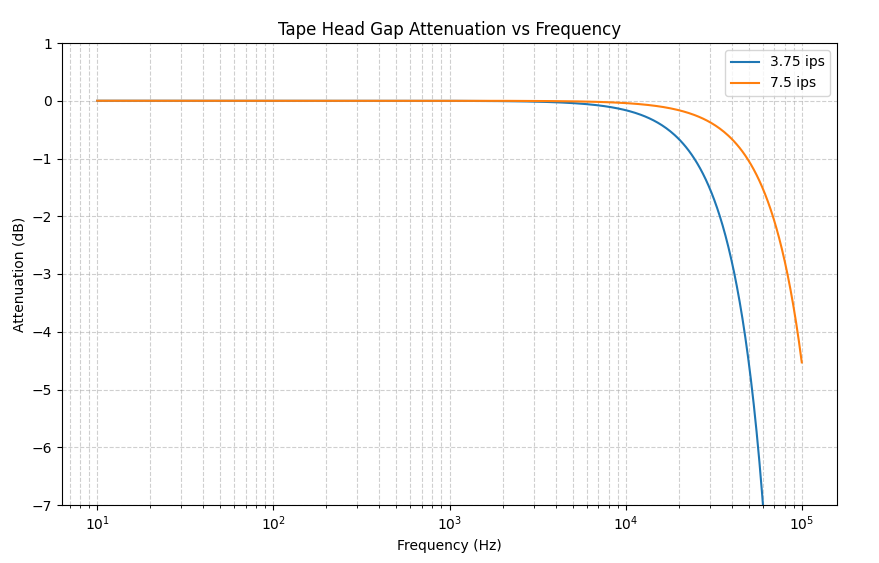
3. There are some Reel to reel machines (for instance a TEAC A-2340S) that have a 1 micron gap which, as shown on the plot below, produce a greater frequency responce. However the smaller gap produces a relativly lower signal strength; thus the frequency responce is enhanced to the detriment of the signal to noise ratio.
 4.
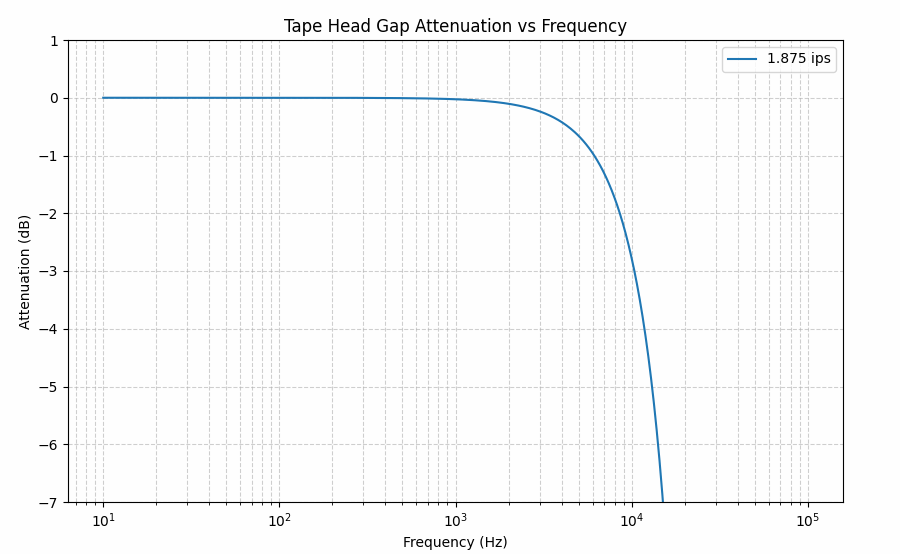
4. Now we need to look at the result expected from a cassette recorder, these have a typical 2 micron head gap.
The tape in cassette recorders normally use 1 7/8 ips for home use.
Of cause the tape formulation and thickness of the oxide layer also changes the frequency responce, however this effect has not been taken into account in the graphs above.
Text and Pictures (C)2026 P.Jolly all rights reserved. Page last updated 20260404