Paul Jolly Photography Chapter 21
Soft and Hard lighting
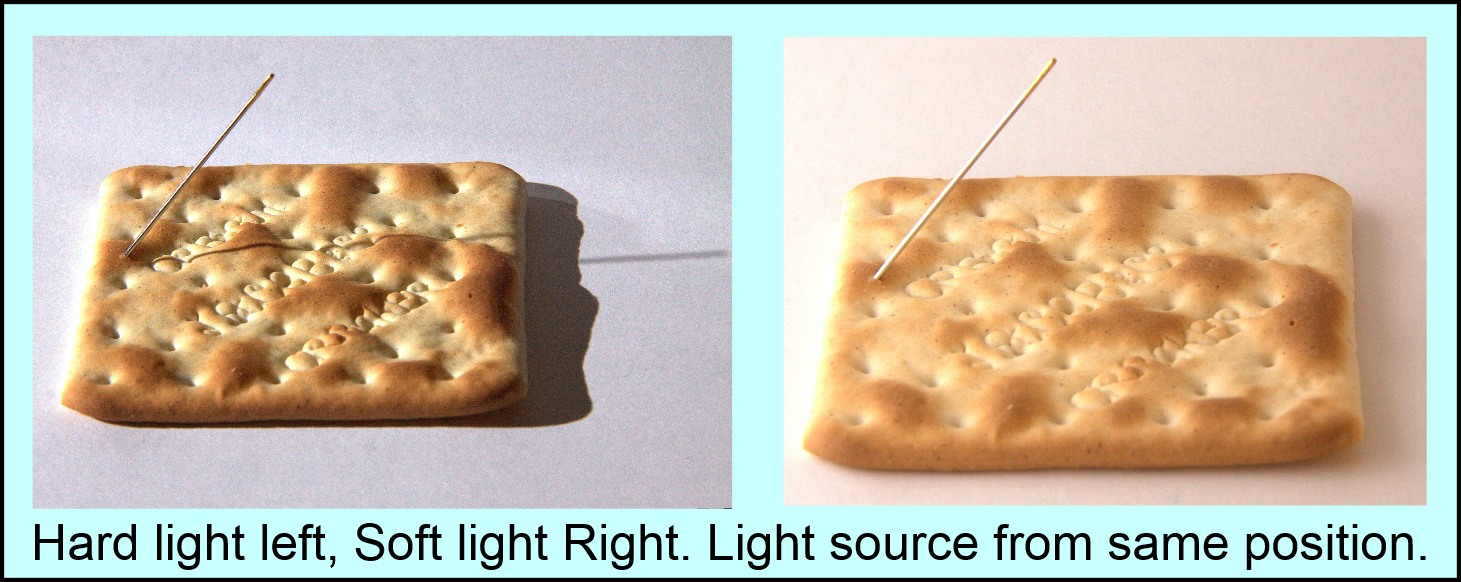
Hard lighting is produced when a spot of light is used to illuminate the scene, edges of objects produce a sharp edged shadow.
Soft lighting is produced when the light source has a large surface area; shadows have a blurred edge.
I have often been amused while travelling round the world, in areas where there is little cloud
cover normal photographs have hard light and soft lighting is used by professionals as it is
harder for the general public to produce soft light. The opposite is the case for countries
with plenty of cloud cover as soft light is the norm.
Using a diffusing sheet between direct sunlight and your subject will produce soft lighting (this
can be an actual bed-sheet opened up). Hard lighting can be produced using a small mirror, this
almost acts as a point source.
Hard lighting emphases surface imperfections and textures; gives deep (dark) shadows. This is a
great lighting method for buildings and objects with rough textures. It emphasises age in portraits
and produces the highest contrast images.
Studio hard light can be produced using a directional strobe or flash, the further away the better
as this will provide the smallest point of light giving the most defined shadows.
Soft lighting smoothes out surface textures and is commonly used for portraits where it reduces lines and wrinkles.
In the studio soft light is produced using a soft box this is a cover over a studio strobe,
normally with a reflective internal curved surface and a diffuser on the front. The larger the
diffuser the softer the light; the diffuser should be as close to the subject as possible (but
still outside the image) as this maximises the angles from which the light illuminates the subject.
Multiple studio lights, with soft boxes, soften the light even more, further reducing shadows that a single soft box will produce.


(C)2024 P.Jolly. Page last updated 20240713